
Table of contents
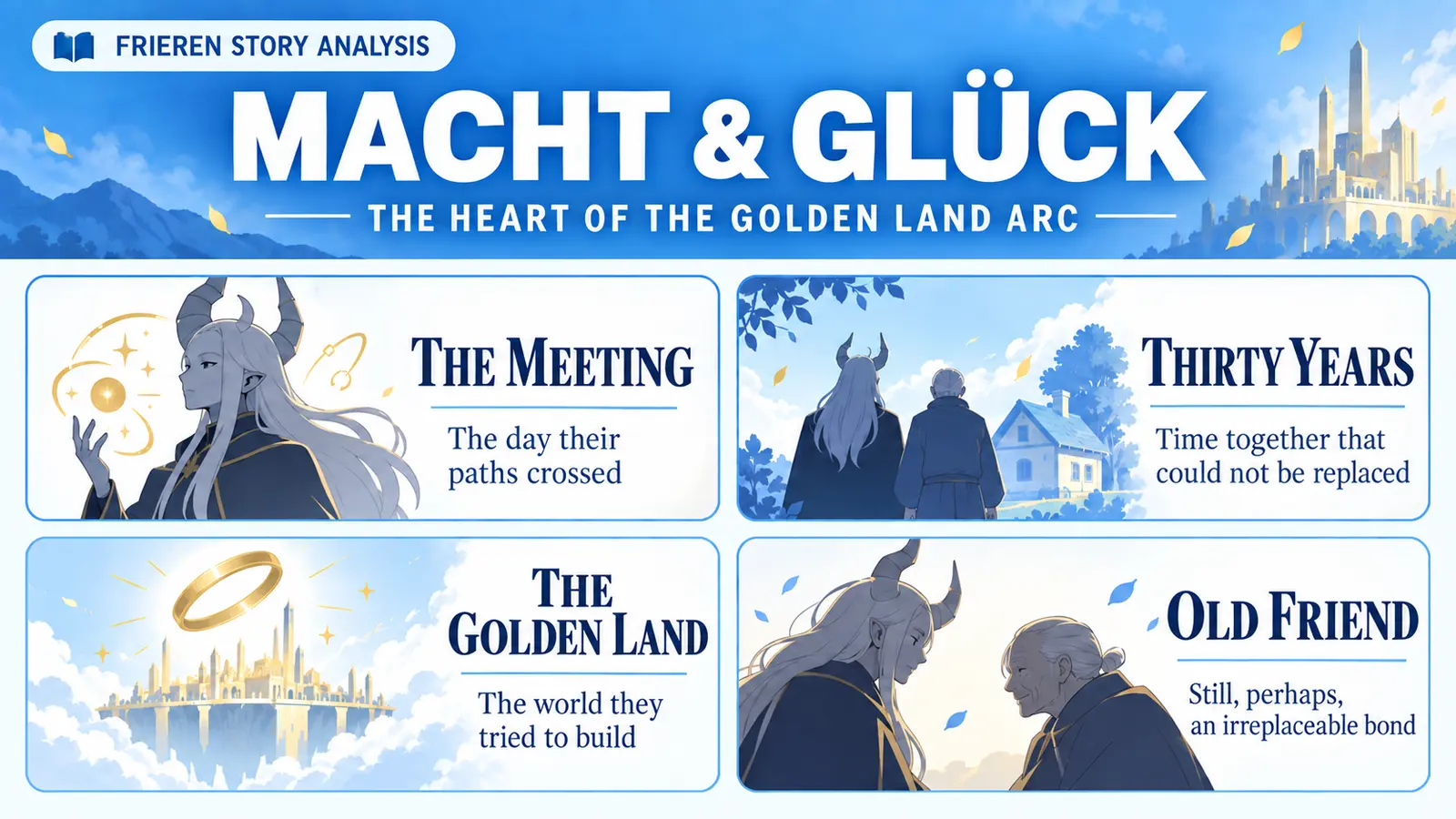
Macht of the Golden Land and Glück, lord of Weise, are often described as friends. That description is convenient—but it is also too clean.
They did not begin with trust. They never came to share the same moral world. Macht could speak about human emotion without experiencing it as a human would, while Glück understood from the beginning that the demon beside him might one day destroy everything he valued.
And yet they spent more than thirty years together. Macht served in Weise, taught Denken, watched Glück’s family change, and remained beside Glück as the human grew old. Even after Weise was turned to gold, their story did not end.
The point of their relationship is not that a demon secretly became human. It is stranger than that: two beings can fail to understand each other and still become irreplaceable parts of each other’s lives.
01 / THE BARGAIN
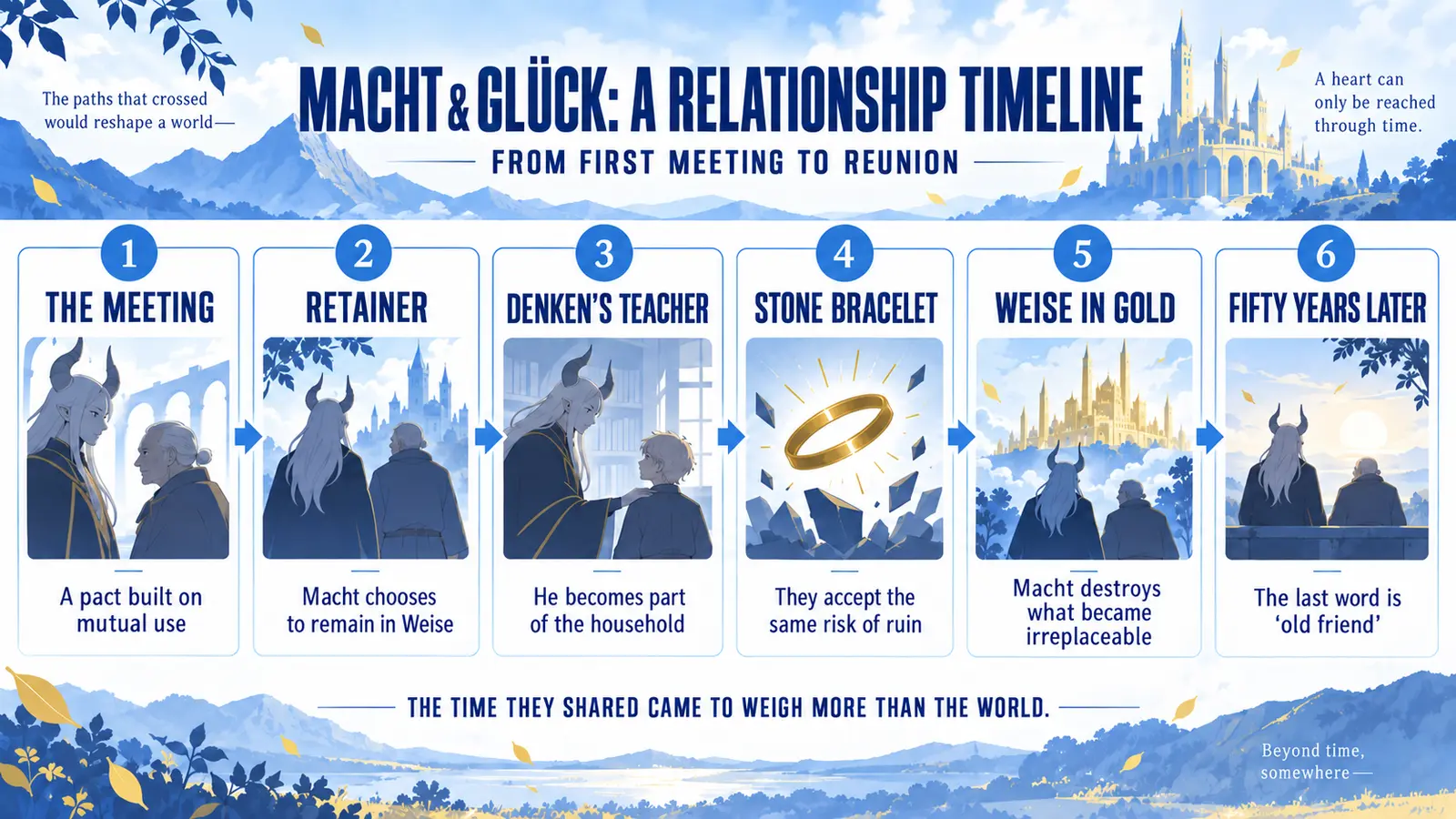
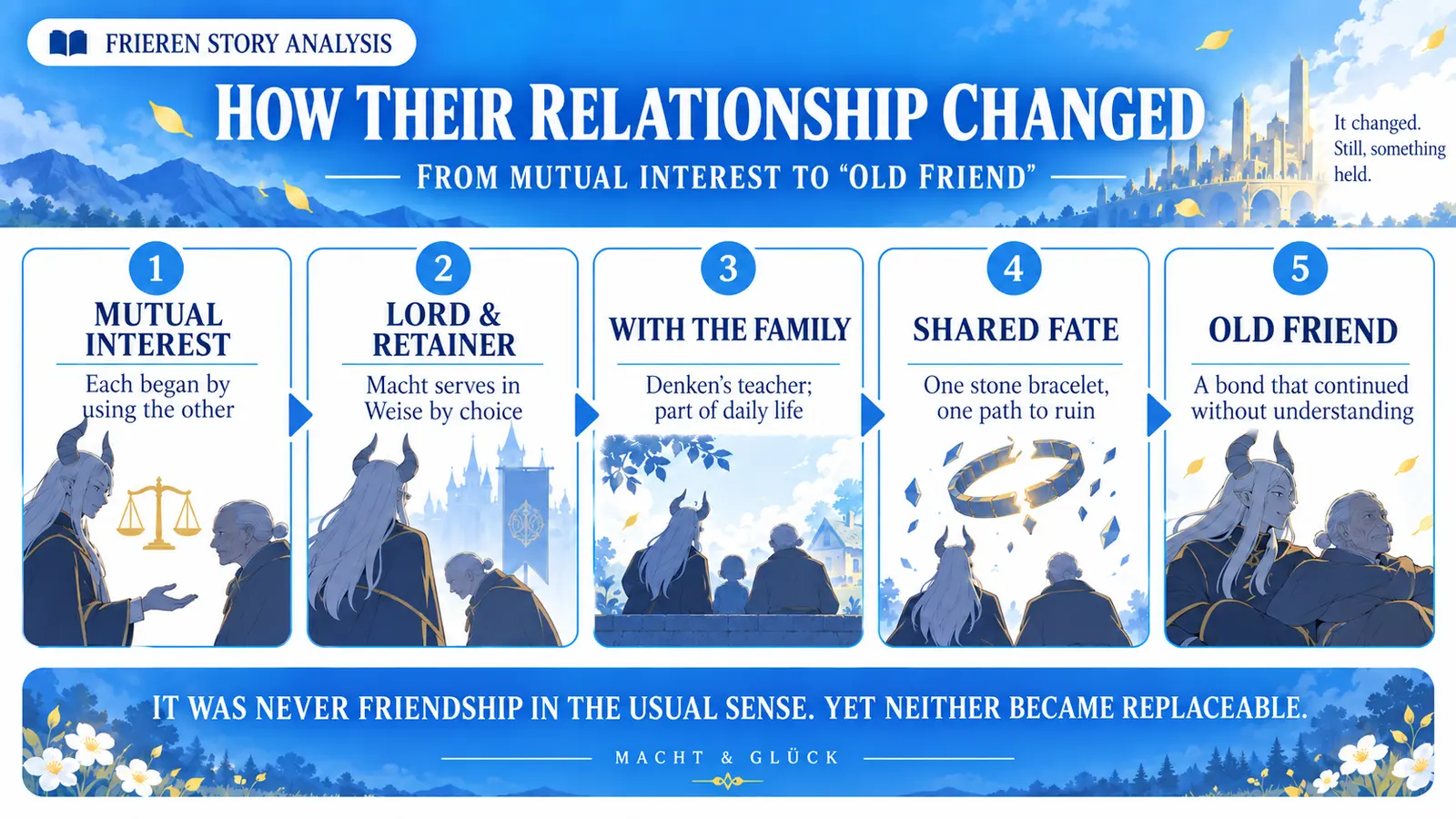
They began by using each other
When Macht met Glück, he was trying to understand concepts that remained closed to demons: malice, guilt, and the human sense that killing another person is morally wrong.
Glück, meanwhile, was fighting for survival inside Weise’s political order. Macht was one of the Seven Sages of Destruction. To a calculating feudal lord, that power was not merely dangerous; it was useful.
Glück offered Macht access to human society and promised to help him study malice. In return, Macht removed Glück’s political enemies.
Macht used Glück as a way into the human heart. Glück used Macht as a weapon.
This matters because the story never rewrites their beginning as a misunderstanding. Their bond grows out of compromise, violence, and self-interest. The later tenderness does not erase the ugliness beneath it.
Macht remained in Weise by choice
Macht eventually became Glück’s retainer, protecting Weise and carrying out the lord’s orders. But it would be misleading to say that Macht stayed only because he was controlled.
The Stone Bracelet of Sovereignty enters the story later. Macht had already chosen to remain with Glück before wearing it. His obedience was not ordinary loyalty, but neither was it simple coercion. Weise gave his search a setting, and Glück gave it continuity.
02 / THIRTY YEARS
The arrangement slowly became a household
Politics explains why Macht entered Weise. It does not fully explain what happened afterward.
Macht taught the young Denken magic. He watched Denken and Lektüre grow up and marry. He spoke with Glück about the family’s future, accompanied him through private grief, and remained present after Lektüre’s death.
None of these moments announces that Macht has “learned friendship.” That is precisely why they matter. The change is structural rather than verbal: the demon who arrived to study humans becomes woven into the routines of a human family.
Meanwhile, time works differently on the two men. Glück ages. He eventually needs Macht’s physical support simply to stand. Macht’s appearance barely changes. The contrast turns their shared years into something visible: one life is passing, while the other continues almost untouched.
The Stone Bracelet bound them to the same ruin
Weise’s nobles feared Macht and demanded the use of the Stone Bracelet of Sovereignty. One condition would kill Macht if he acted with malice toward the people of Weise.
Glück recognized the flaw immediately. Macht did not understand malice in the human sense, so a rule triggered by malice might never restrain him at all.
Macht accepted the bracelet for the same reason it frightened everyone else. If it killed him, then perhaps he would finally have proved that he could feel the very thing he had been studying.
The bracelet therefore did more than control a demon. It exposed the logic of the partnership. If Macht fell, Glück’s political order would fall with him. If Glück’s project collapsed, Macht would lose the human world he had spent decades observing. They had made themselves vulnerable to the same ending.
03 / THE GOLDEN LAND
Why Macht turned Weise into gold
After decades among humans, Macht still could not grasp guilt. He therefore designed a final experiment: destroy something he himself considered irreplaceable and see whether the loss produced a human response.
The chosen subject was Weise—not a random city, but the place containing Glück, Denken’s childhood, Lektüre’s memory, and the accumulated shape of Macht’s own life.
Glück was not surprised. He had watched Macht long enough to understand where the demon’s inquiry might lead. The two did not stage a final moral confrontation. They looked back over their years together, and then Macht transformed the city and its people into gold.
The experiment failed on its own terms. Macht did not die from the bracelet. He did not suddenly understand guilt. Even after destroying what he called irreplaceable, he could not interpret his response in human language.
The experiment contained a contradiction from the start
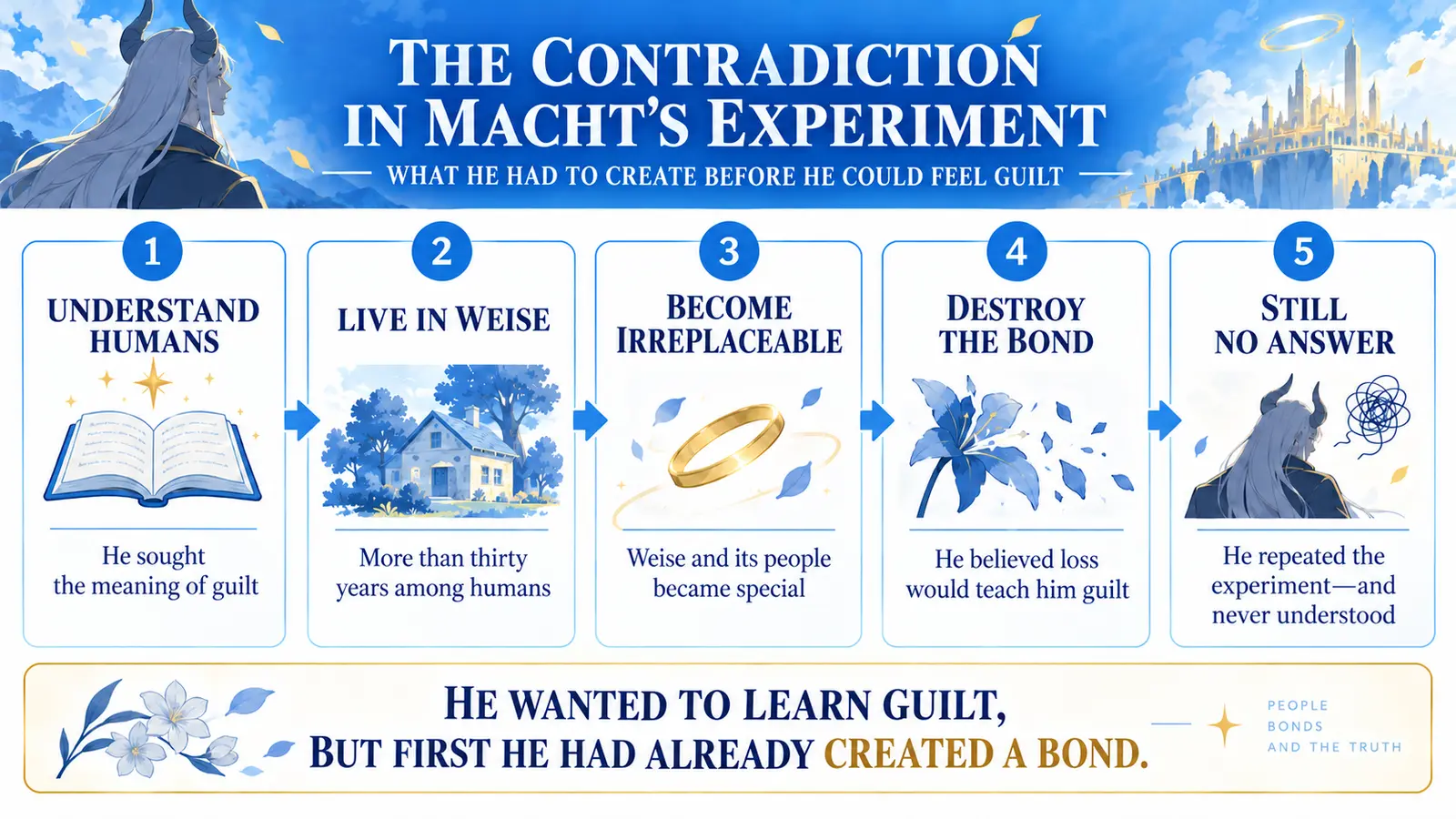
To feel guilty about destroying something, Macht first needed something he did not want to lose.
That means his experiment required him to spend decades creating the very attachment he planned to test. Weise had to stop being a sample. Glück had to stop being interchangeable. The relationship had to become real before its destruction could mean anything.
Before Macht could test whether he felt guilt, he had already done something his original theory could not explain: he had made a human life matter to him.
This does not prove that Macht felt friendship exactly as Glück did. It suggests something more unsettling. Macht may have possessed a form of attachment while lacking the human framework needed to recognize and name it.
04 / FIFTY YEARS LATER
Glück’s return does not become a scene of forgiveness
When the transmutation of Weise is undone roughly fifty years later, Glück returns to a world that has moved on. Macht, mortally wounded after his battle with Denken, meets him once more.
Glück does not offer absolution. More importantly, he does not need to. Forgiveness would require the scene to become a moral negotiation between two humans who share the same assumptions about harm, remorse, and responsibility.
Instead, Glück speaks to Macht with the familiarity of their former life. When Macht threatens to kill Glück in order to stop Denken, Glück understands the performance immediately. The threat tells him that Macht is already beyond saving.
Glück then gives Denken permission to finish the battle and names Macht with the language of an old, troublesome friend.
From here, the text stops explaining. The remaining answer lives in the space between the words.
05 / THE SPACE BETWEEN
Why “old friend” is more revealing than “friend”
The Japanese word in the scene is akuyū—a “bad,” “wicked,” or troublesome friend. This essay uses “old friend” as readable shorthand, but the darker modifier is essential. Glück does not purify the relationship at the moment of Macht’s death.
He knows Macht never became human. He knows the demon destroyed Weise. He knows that living beside Macht was dangerous from the beginning.
Yet Glück also refuses to pretend that those thirty years were empty.
That makes the final name neither praise nor condemnation. It holds both at once: complicity, affection, danger, habit, memory, and a history no moral label can simplify.
Understanding friendship is not the same as becoming attached
The arc quietly separates two questions that stories often treat as identical:
ACan Macht understand the human concept of friendship?
BCan Glück become uniquely important to Macht?
The answer to the first may remain no. The answer to the second is harder to deny.
Macht stayed in Weise for more than thirty years. He taught Denken, accompanied Glück, supported his aging body, and came to call the city irreplaceable. Those facts do not require him to experience friendship in a human way. They do show that this particular place and these particular people stopped being replaceable.
Human beings can look back at such a history and name it. Macht cannot. Glück can—and does.
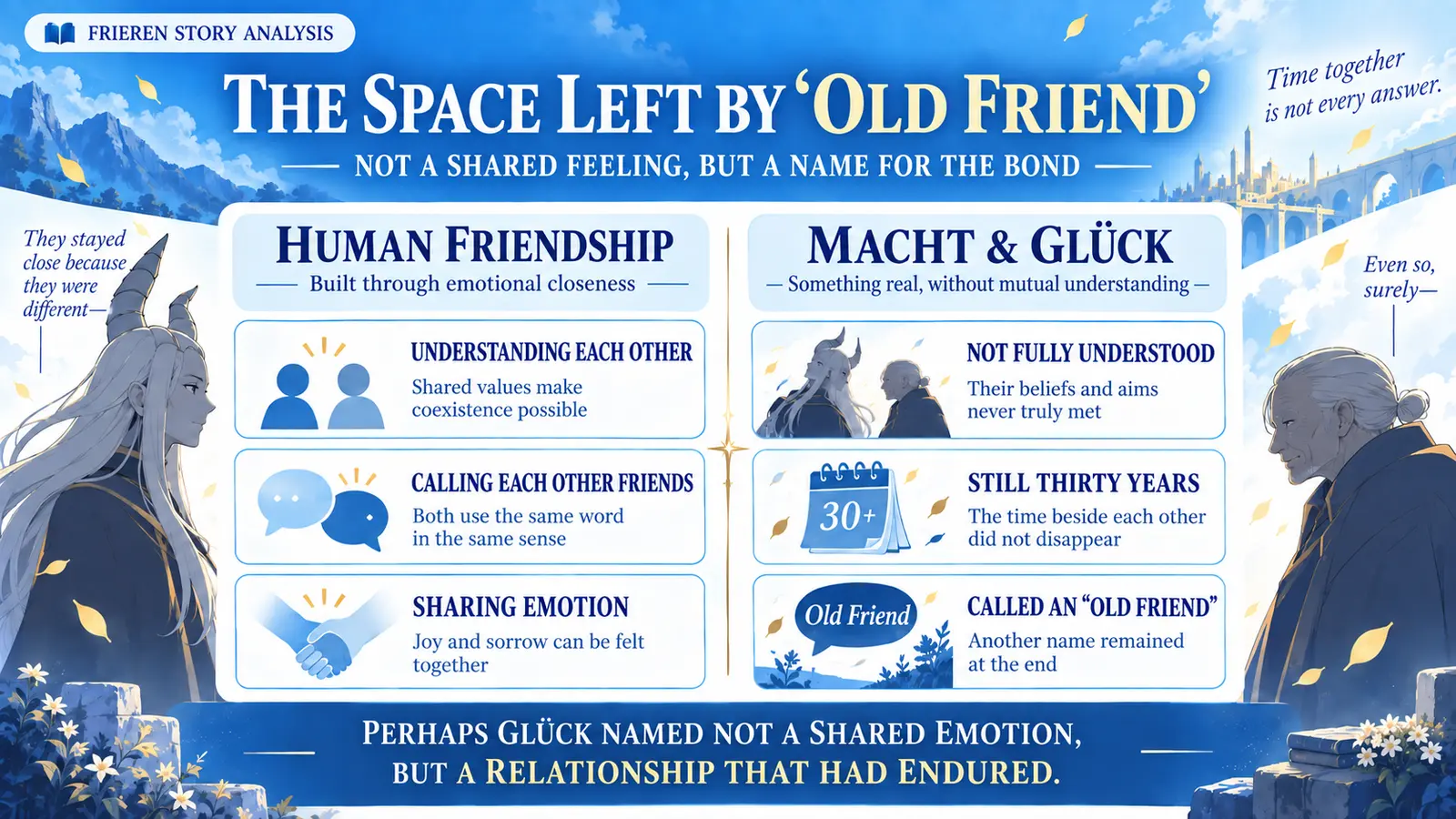
Glück names the relationship Macht cannot name
Macht approaches emotion as if each feeling were a separate problem with a discoverable rule: malice, guilt, grief, affection. Human relationships do not remain inside those borders.
His life with Glück contains all of these tensions. It begins as exploitation, becomes service, grows into domestic familiarity, and ends in catastrophe. No single category explains the whole.
That may be the final limit of Macht’s search. He was not necessarily incapable of every feeling. He was incapable of doing what humans constantly do: gathering contradictory experiences together, assigning them meaning, and giving the result a name.
Glück performs that final act for both of them.
CONCLUSION
Their bond endured because the story refused to make it simple
Macht and Glück met to use each other. Macht became Glück’s retainer and Denken’s teacher. More than thirty years passed, until the city and the people within it became irreplaceable to him.
Then Macht destroyed Weise because he believed loss might finally teach him guilt. It did not. The story never rewards his experiment with a last-minute human revelation.
That refusal is what gives the relationship its force. Macht remains a demon. Glück never denies the danger or the damage. Neither is rescued by the other.
They did not need to share the same heart for a relationship to come into existence.
The years remained. The habits remained. Glück’s understanding remained. And when Macht could not name what those things had become, Glück supplied a name that was affectionate, accusatory, and unresolved all at once.
That unresolved bond is the quiet center of the Golden Land arc.
The argument in three lines
Macht and Glück began by using each other, but their arrangement became more than thirty years of shared life.
Macht could not understand guilt or friendship as a human would, yet Weise and Glück still became irreplaceable to him.
Glück’s final name for Macht describes not a shared emotion, but a morally unresolved relationship that truly existed.
Terminology note
Character and place names follow the official English spellings: Macht, Glück, Weise, Denken, and Lektüre.
The artifact is named the Stone Bracelet of Sovereignty in the official English chapter title.
“Old friend” is used here as an interpretive rendering of akuyū; its sense of a bad or troublesome friend remains central to the analysis.
READERS’ NOTES
Join the discussion
Share what stood out to you, or how you read the story.
No comments yet. Be the first to leave a thoughtful note.