
Table of contents
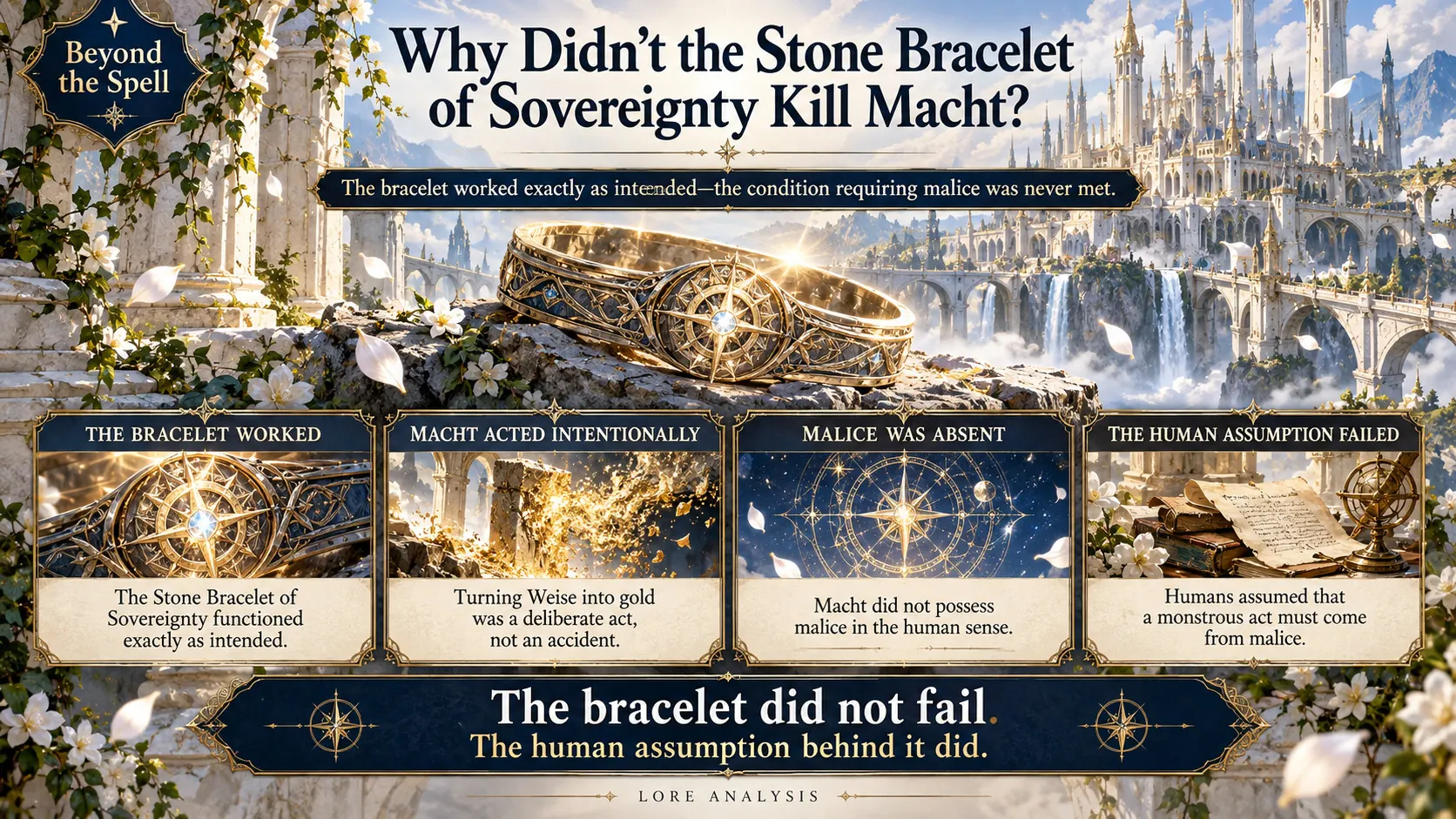
Macht of the Golden Land turned the fortified city of Weise—and its people—into gold. He understood what his magic would do. He chose to do it anyway. Yet the Stone Bracelet of Sovereignty, which was supposed to kill him if he acted with malice toward Weise, remained silent.
The tempting explanation is that the bracelet failed. But the Golden Land arc points toward a colder answer: the bracelet worked exactly as designed, and Macht never satisfied its trigger condition.
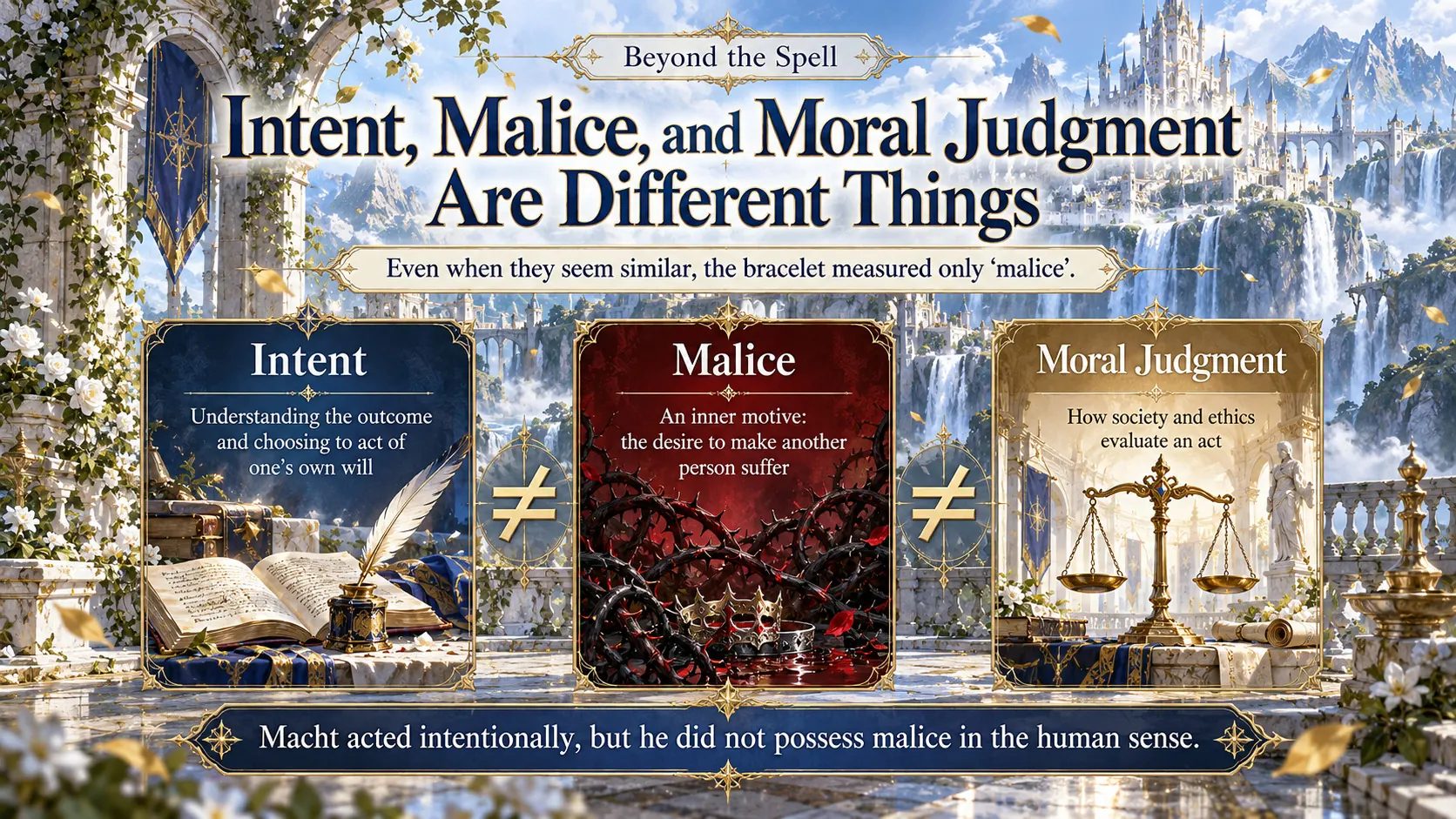
That answer only makes sense if we separate three ideas that human moral language often collapses into one:
- Intent: understanding a result and choosing the act that produces it
- Malice: an inward wish to harm, humiliate, or make another suffer
- Moral judgment: the human evaluation that an act is wrong or evil
Macht acted intentionally. Humans rightly judge the result as monstrous. But the bracelet did not measure either of those things. It measured malice.
01 / THE ANSWER
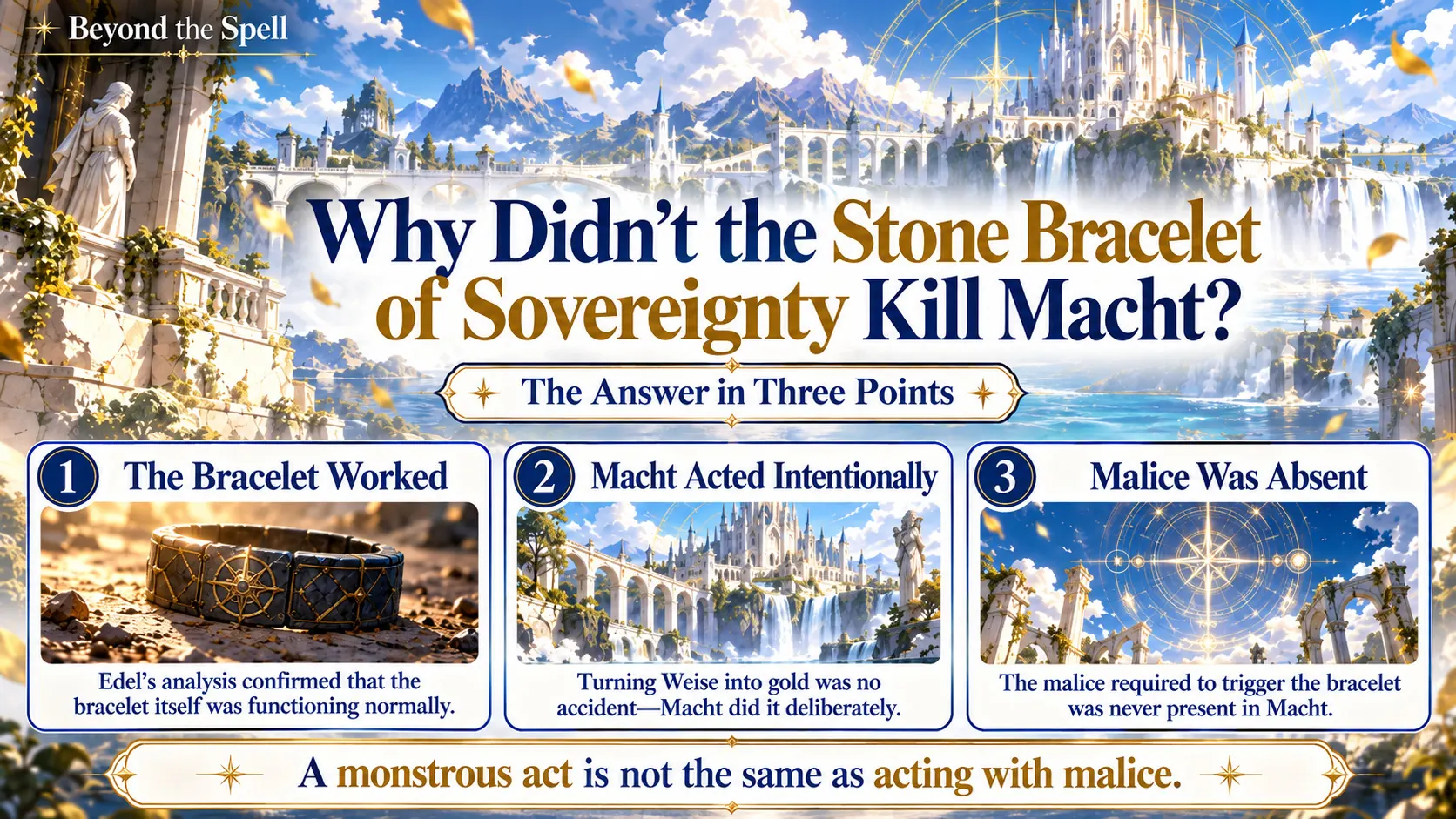
The bracelet was functioning correctly
The Stone Bracelet of Sovereignty is not presented as a broken artifact. Its threat is real: if Macht violates the engraved condition, the bracelet can kill him. The crucial question is therefore not whether it possessed enough power, but whether its condition was fulfilled.
That condition was framed around malice toward the people of Weise. It was not a blanket prohibition against harming them. It did not say, “You may never cast Diagoldze on this city,” or “You may never knowingly cause its destruction.”
The difference is decisive. A command aimed at a specific emotion can only activate when that emotion exists in the form the command recognizes.
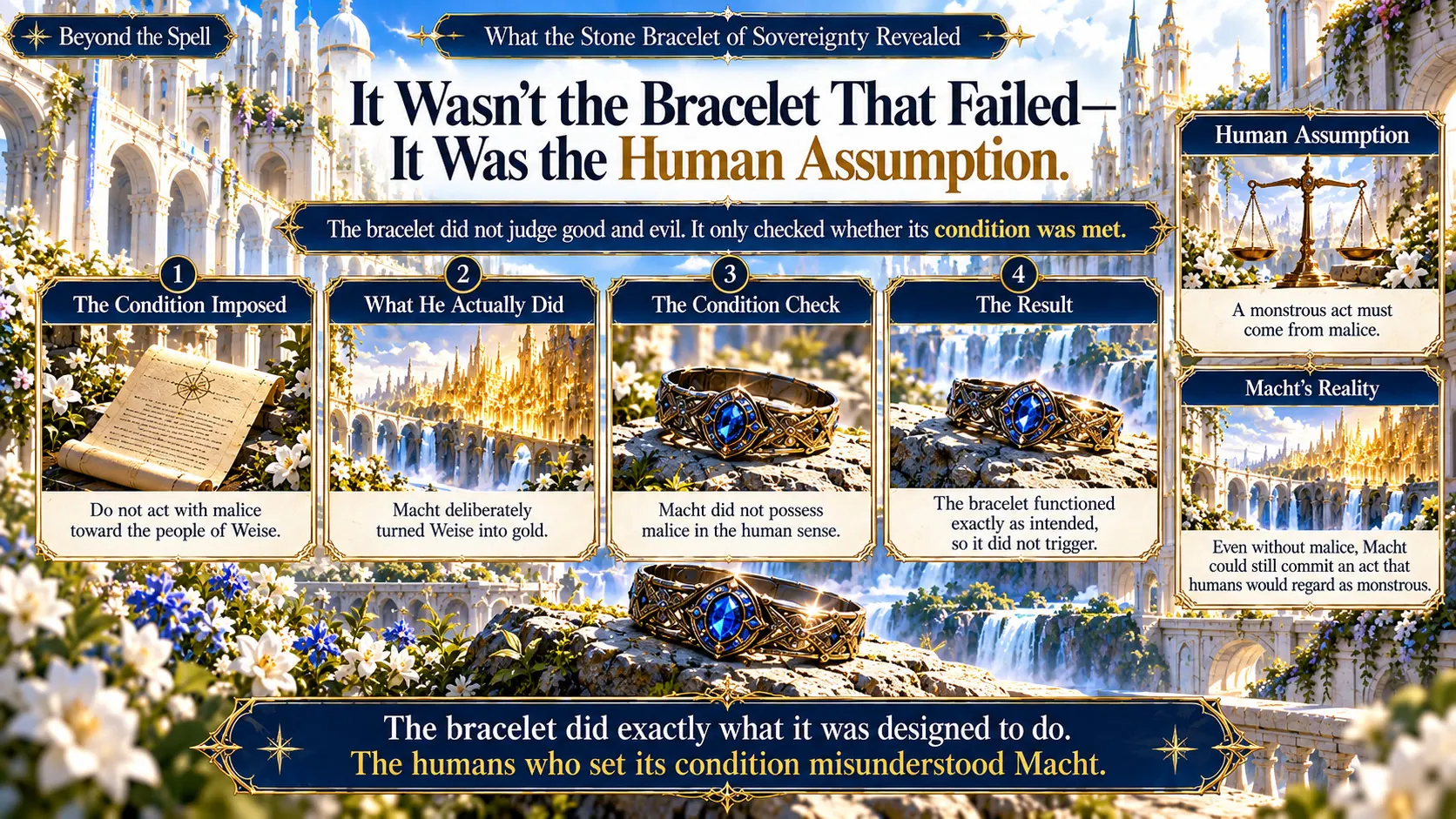
The bracelet did not judge whether Macht’s act was evil. It checked whether the motive defined as malice was present.
When Macht transformed Weise, the physical result was catastrophic. The magical condition, however, remained false. No trigger meant no punishment.
02 / THE CONDITION
The humans tried to control an action by regulating an emotion
Why write the rule this way? Because human beings usually assume that extreme cruelty must be preceded by a hostile inner state. If someone knowingly destroys an entire city, we expect hatred, resentment, sadism, or at least a desire for the victims’ suffering.
For an ordinary human subject, banning malice might seem broader and safer than banning a list of actions. Stop the hostile motive at its source, and many harmful acts should become impossible.
But that logic depends on a human model of mind. It assumes that intention, malice, and moral evil reliably travel together. Macht is dangerous precisely because they do not.
He can predict the consequences of an act without sharing the emotional structure humans expect behind it. The command was precise. The model of its target was not.
03 / THE DISTINCTION
Macht intended the result—but intention is not malice
Macht did not transform Weise by mistake. He understood that Diagoldze would engulf the city. He also knew that Glück, the people he had lived beside, and the place he called irreplaceable would be taken with it.
So saying that Macht lacked malice cannot mean that he lacked knowledge or agency. It describes his motive, not his competence.
His purpose was experimental. Macht had spent years trying to understand human concepts such as malice and guilt. He concluded that destroying something precious to him might finally produce the missing feeling. Weise became the subject because it mattered.
From a human perspective, using a city and its inhabitants as material for an experiment is already morally abhorrent. But the object of Macht’s desire was not their pain. He wanted to observe a change in himself.
This distinction explains the apparent paradox. A deliberate act can be morally evil without being animated by the specific feeling called malice.
The bracelet’s silence was not a verdict of innocence
“Macht felt no malice” can sound like a defense if it is treated as ordinary moral language. It is not. Weise was transformed, its people lost decades of life, and Macht was responsible for the act.
The bracelet’s result was technical, not ethical. It did not weigh the victims’ suffering, infer social responsibility, or issue a moral verdict. It evaluated a condition and found that condition unmet.
The bracelet’s silence was not an acquittal. It was evidence that human ethics could not be copied directly into a demon’s inner life.

04 / THE EXPERIMENT
Why Macht accepted a bracelet that could kill him
If the artifact posed a genuine threat, why did Macht agree to wear it? Because its condition overlapped with his own inquiry.
- If the bracelet killed him, he would have evidence that he had finally developed malice.
- If it did not react, he would learn that the concept still escaped him.
- Either outcome would produce information about the thing he wanted to understand.
The bracelet was therefore more than a restraint. To Macht, it was also an instrument capable of testing his interior state.
His willingness to remain in Weise cannot be reduced to the artifact, either. Macht had already chosen to live beside Glück before the bracelet was imposed. Their decades together gave the later experiment its terrible weight. For the full history of that bond, see our analysis of Macht and Glück’s relationship.
The deeper failure was not magical. It was conceptual.
05 / THE HUMAN PREMISE
The failure was not the magic tool, but the human assumption behind the command
The people who created the condition believed that a sufficiently terrible act would necessarily arise from malice. In human life, that correlation is strong enough to feel like common sense.
Macht exposes the hidden premise inside that common sense. He can value Weise without treating that value as a prohibition. He can destroy what is precious without hating it. He can understand the consequence of an action without experiencing the human motive that would normally explain it.
The bracelet faithfully processed the input it was given. What failed was the human theory used to write that input.
Macht was not emotionless—his emotions did not produce human ethics
The arc does not portray Macht as a blank machine. He recognizes Weise as irreplaceable. He treats his years with Glück as singular. The city and its people are not interchangeable specimens by the end.
But emotional significance does not lead him to the same ethical conclusion it would produce in a human. A person may think, “Because this matters to me, I must protect it.” Macht thinks, “Because this matters to me, destroying it may finally reveal what guilt is.”
That gap is more unsettling than simple cruelty. Macht can approach human language, attachment, and social life closely enough to appear understandable—while the behavioral rules he derives from them remain radically different.
The Golden Land arc is about an intelligence that cannot be safely mapped onto ours
Macht studies humans for decades. He speaks with them, lives inside their institutions, teaches a human child, and builds a history with Glück. None of this is meaningless. Yet proximity does not produce a shared moral architecture.
The Stone Bracelet of Sovereignty makes that separation visible. The humans believed they had translated an ethical boundary into a magical rule. In reality, they had translated a human assumption—and the difference only became visible when the rule met a mind unlike their own.
That is why the bracelet’s failure is so important. It is not merely a clever exception in a magic system. It is the Golden Land arc’s central problem rendered as a binary result: the same words do not guarantee the same inner world.
CONCLUSION
Why the Stone Bracelet of Sovereignty did not kill Macht
The bracelet worked. Macht intentionally transformed Weise into gold. But the condition of malice was never met.
Intentional harm, malicious motive, and moral condemnation are related in human life, but they are not identical. Macht’s act satisfied the first and the third. The artifact had been ordered to respond only to the second.
The result does not absolve Macht. It reveals the limits of the people who tried to control him with a human theory of evil.
The command was exact. The assumption inside it was wrong.
The bracelet’s silence is the Golden Land arc’s coldest answer: human common sense was never enough to bind a demon.
The argument in three lines
The Stone Bracelet of Sovereignty was functional and evaluated the condition it had been given.
Macht deliberately transformed Weise, but he did not act from the human-like malice the bracelet measured.
The failed safeguard exposed a human assumption: that every monstrous act must begin with a malicious motive.
Terminology note
Character and place names follow the official English spellings: Macht, Glück, Weise, and Denken.
The artifact is called the Stone Bracelet of Sovereignty in the official English chapter title. “Bracelet of Sovereignty” is used only as a shortened reference.
READERS’ NOTES
Join the discussion
Share what stood out to you, or how you read the story.
No comments yet. Be the first to leave a thoughtful note.